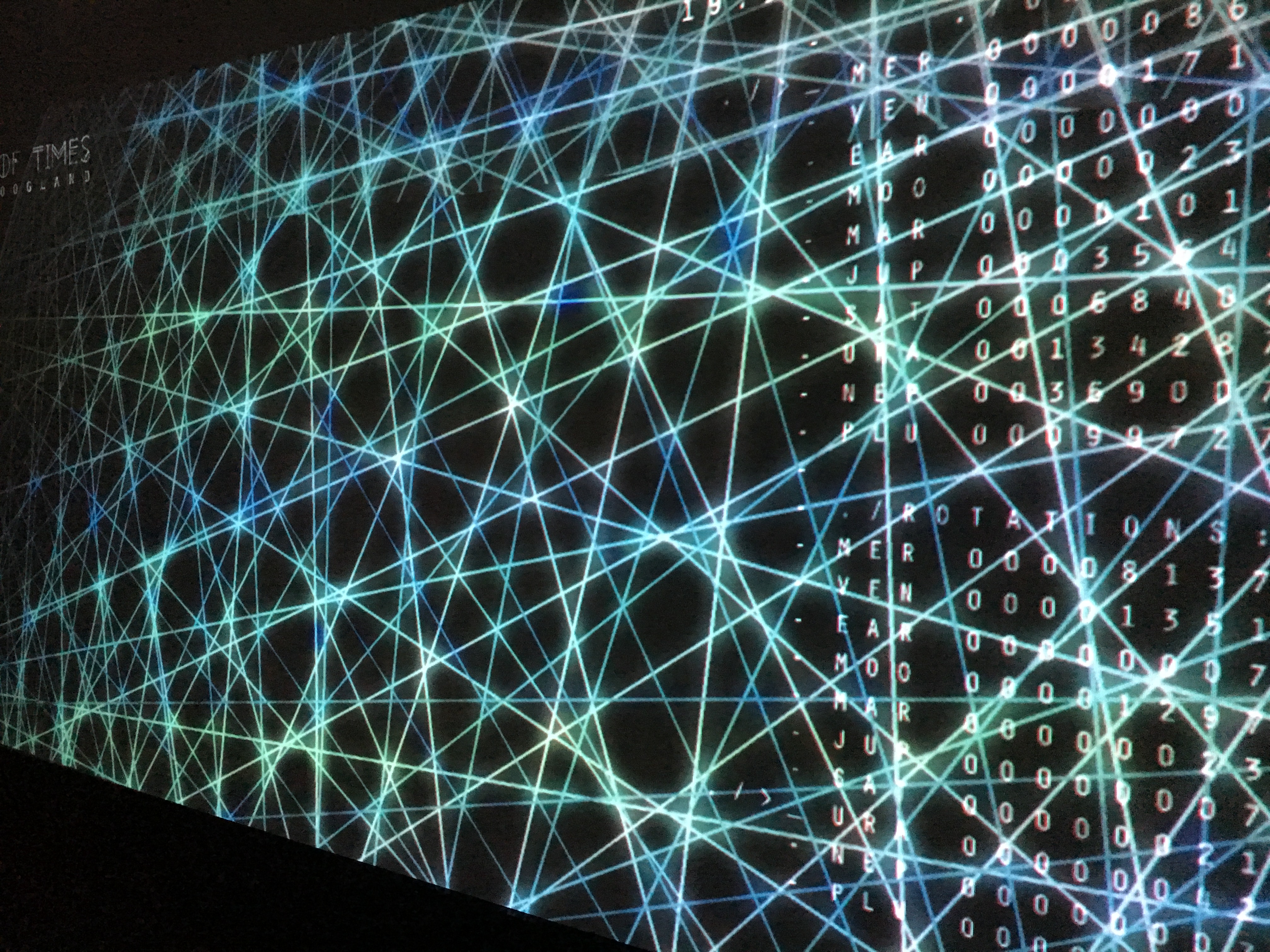
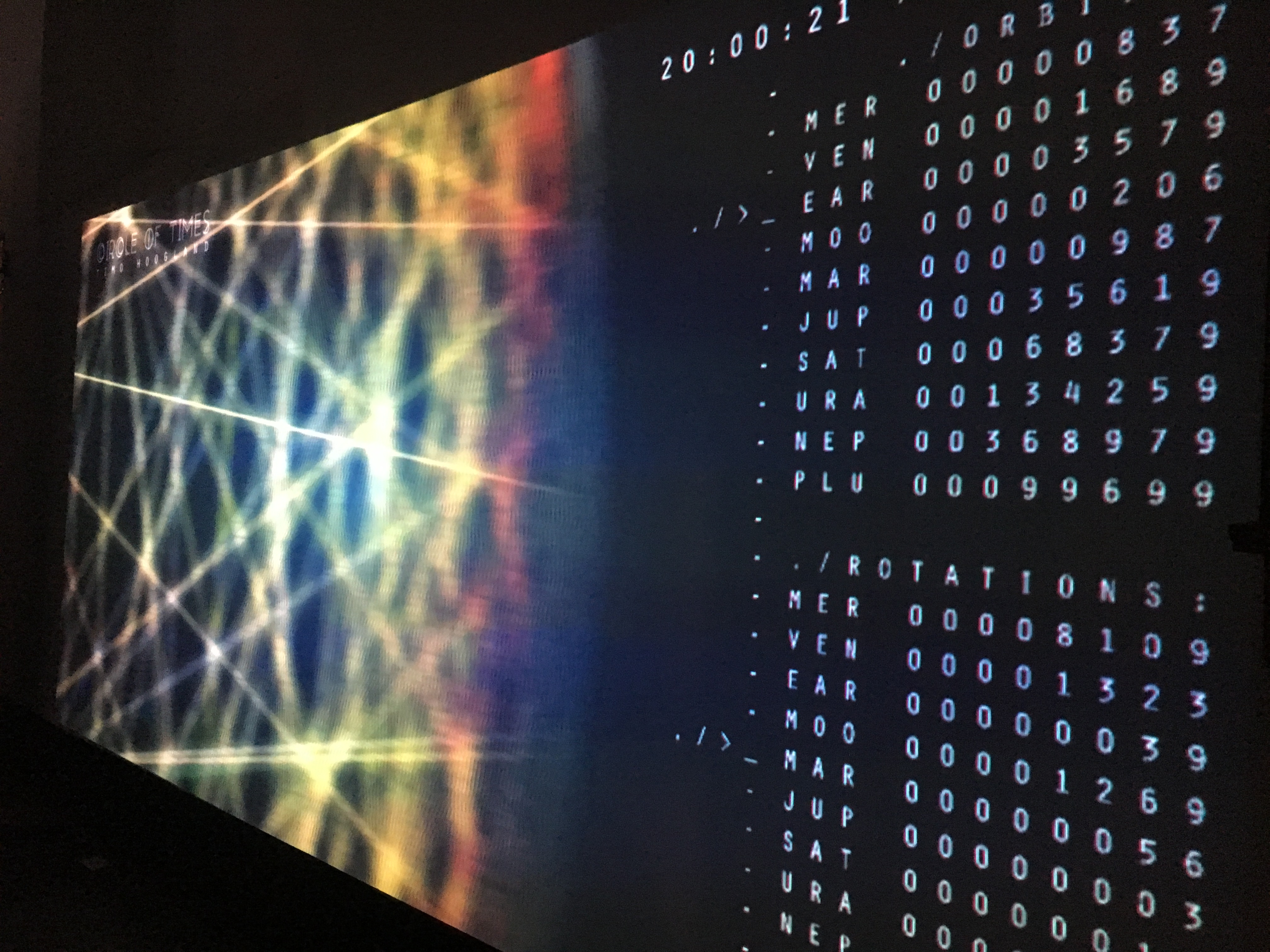
circle of times

Exhibitions
2018 dec 22 : Circle of Times at GOLF Festival, Pletterij, Haarlem NL
2018 dec 07 : Circle of Times Exhibit at Bring Your Own Beamer, Chinastraat, Ghent BE
2018 sep 29 : Circle of Times at Bring Your Own Beamer, Nicolai Church, Utrecht NL
About
Time is the subject in this realtime algorithmic audiovisual composition. Various interpretations of time are explored. The mathematical structure somewhat resembles a giant mechanical clock. It makes you rethink the influence that time has in our lives. The structure feels threatening, as if eventually it might take over…
The 24-hour clock is the backbone of the composition, of which the total amount of seconds passed are used to trigger events. When using the length of days and years of the planets in our solar-system in ratio to earth, scaling those ratios back to a shorter period of time (1 earth-day equals 1 minute), a rhythmic pattern emerges. This pattern triggers the events that drive the mathematical visual structure that somewhat resembles a gigantic clock. When an event is triggered, the current second is used to draw lines inside the circle. These lines are based on the times-tables. Multiply every point in the circle with that current second, then draw a line from the starting point to the point that corresponds with the answer. The sounddesign is build with a large amount of resonators that are either driven with noise, an impulse, or sawtooth and rectangle waveforms. Programmed with MaxMSP, Jitter and JavaScript.
In-depth
The project Circle of Times is a result of my exploration in programming various kinds of visuals with Max and Javascript. Time is the subject in this real-time algorithmic audiovisual composition. Various interpretations of time are explored. The mathematical structure somewhat resembles a giant mechanical clock.
Visualizing the times-table
I programmed a version of the times tables multiplications circle as described by Simon Ploufle, a French mathematician who experimented with the algorithms between 1974 and 1979.
The phenomena of light-rays reflecting on the inside of a coffee cup results in the shape of a cardioid. The algorithm is described as “a circle divided into p (prime) parts and by taking 2^n mod p, 2 being a primitive root of p (so that there are p-1 residues) a cardioid is generated”. While his original algorithm is slightly different, it roughly translates to a times table n * f mod p. Where p is the total number of points in a circle, n is the integer number of a single point and f is the multiplication factor. The algorithm to draw the lines then becomes:
Take a circle of evenly spaced points. Number the points, starting at
0up till the amount ofpoints-1. For every point apply the functionn * f mod p. Draw for every point a line to the corresponding point of the result of the function. For example take 10 points and a factor of 2. Point 1 multiplied by 2 is 2, so a line is drawn from point 1 to 2. When the result of the multiplication exceeds the number of points, the modulo operation is applied. In example point 7 times 2 equals 14, which is more then 10. 14 modulus 10 results in 4. The point is now drawn from 7 to 4.
With a large number of points and a factor of 2, the cardioid appears. With other factors varying intruiging patterns arise based on the positions the lines are drawn. The following code is an example written in p5.js javascript .
Data sonification with complex mapping
The mathematics that underlay the visuals are also generating the sound. While working on sound design and the visuals, it struck me that the circle somewhat resembled a mechanical structure, like a clock. And because the algorithm is about multiplication (times), the word time got another meaning. To make a physical model of the sound of a clock, a few resonating bandpass filters are tuned to certain frequencies of the body-resonance (Farnell, 2010) . Exciting these filters with a short burst of white noise results in a chick-chock sound. The frequencies used in the tuning determine the timbre of the body, which results in wooden, plastic or metallic sounds (and varieties in between). The filters are tuned to a lower pitch that, combined the clicks with pitchshifted sounds of metal pipes scraping over concrete, results in the sense of a big and heavy metal clock.
The translation of the data to sound, commonly referred to as sonification, is achieved with a complex mapping that determines the character of the instrument and can bring it to life (Hunt et al., 2002) . In order to represent the resulting data of the function n * b mod p in sound, I took the concept of resonating bodies and build a bank of 30 resonators.
Structures from planetary orbitals and rotations
One layer higher in the composition is the rhythmical structure. The concept of time in this layer is represented by the rotations and orbitals of the planets in our solar system (Williams, 2018) . Every planet has a different orbital and rotational period. When scaled down to a shorter period of time, a polyrhythm emerges. This happens because, after all the planets start aligned, some planets will make more orbits in the same time as others before aligning back up. The proportions in the movement between the planets is also referred to as the Harmony of the Spheres, coined by Pythagoras (Weiss & Taruskin, 2007). Kepler later describes how the relative rotational speeds of the planets are almost consonant musical intervals (Kepler, 1939). Pythagoras and Kepler both described the proportions as a tonal intervals, but the cyclic differences can also be interpreted as a rhythm. An influential work in modern electronic music that was inspired by the Harmony of the Spheres and has a similar approach to data sonification is Laurie Spiegel’s Harmony of the Worlds , which was included on the Golden Record for the Voyager I.
For my piece 60 seconds represents one Earth-day and the length of the days for the other planets is scaled in ratio to that. Every time a new year or day is started the planet triggers an event in the composition, changing the multiplication factor based on the total amount of seconds passed. The new factor will then in its part change the frequencies of the resonators. The color scheme of the structure reects the colors of the planet triggering the event.
Images